
The business
- An eligible operating business under current SBA rules.
- Verifiable earnings support the debt; Owner Buyout coverage generally starts at 1.25×.
- A supportable price and sufficient post-sale operating cash.
Simplifying sophisticated financial strategies for small business owners, investors, and their families.
 Simplifying sophisticated financial planning for small business owners and their families.Clarity. Confidence. Coordinated Execution.352-766-1994
THE SECOND OFFER™ · OCTOBER 2026 SBA UPDATE
New rules effective October 1, 2026You built the business. Could the person who helps run it become the person who buys it?
Certain inside buyouts deserve a fresh look. Lender approval and policy conditions apply. War Room is an educational resource, not a lender.

START HERE · THE SIMPLEST EMPLOYEE-BUYOUT ROUTE
This quick screen is for a sole owner selling 100% to an employee. Other owner and partial-buyout paths have different rules.
Choose an answer in each column to see the next question to investigate. No personal details needed.
A discussion screen, not a complete eligibility test or loan decision. Required equity reduction depends on lender discretion, adequate liquidity and working capital, and nonnegative last-fiscal-year-end net worth. A “no” may mean a different route—not that all SBA financing is unavailable.
See restrictions, exceptions and lender verification ↓THE IMPROVED FREE SAMPLE · PAPA JOE’S FAMILY
A sale can change your cash, taxes, investments and retirement options at the same time. Papa Joe’s fictional case shows why those decisions deserve to be weighed together.
“Prepare a coordinated business transfer and retirement plan.”Papa Joe’s stated objective · fictional
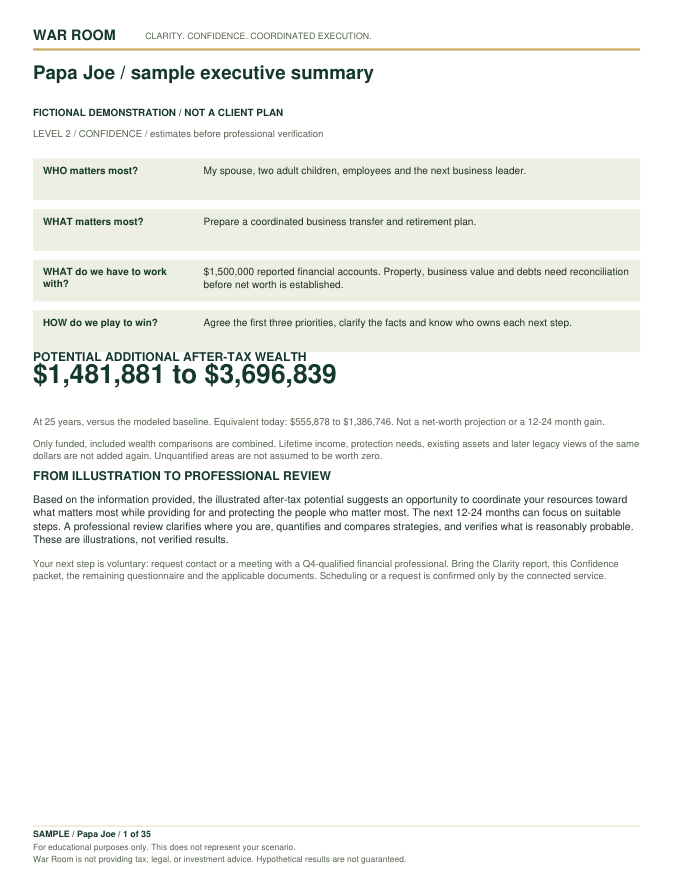
At year 25, versus the modeled baseline. Not cash today or an SBA financing benefit.
Lower illustrated assumptions. The higher sensitivity totals $3,696,839. Neither is a forecast.
 OPEN THE ACTUAL SAMPLE ↗
SEE THE ASSUMPTIONS. NOT JUST THE HEADLINE.
The sample combines only three modeled wealth differences. Insurance protection, existing assets, total sale proceeds and later views of the same dollars are not stacked onto the total.
Second Offer financing is unquantified in this packet. It assumes a full-cash business transfer at year 5; financing and seller-note credit risk are not modeled. This $4.5M-revenue family case is separate from the quick calculator’s up-to-$2M audience.
Business: $625,000 baseline normalized EBITDA; lower/higher improvements of $100,000/$175,000, phased in over five years. Transfer multiples of 4.0×/4.5× apply to improved earnings. The model deducts working-capital retention, simplified taxes, $25,000 program costs in each of years 1–2 and foregone growth.
Investing: 4.50% baseline versus 4.75%–5.00% assumed net returns on specified existing and baseline capital; a $9,520 transition tax and its foregone growth are included. These are sensitivities, not promised investment outperformance.
Roth: a $500,000 pre-tax tranche assumed surplus to living needs, with phased conversions in years 6–10. Outside-funded conversion taxes, annual review costs and foregone growth are deducted. Baseline after-tax required withdrawals are reinvested.
Endpoint: owner age 80, 25 years from the starting point. Nominal additional after-tax wealth, not a net-worth forecast, current savings or a 12–24-month gain. Operating results, returns, taxes, fees and liquidity may materially reduce or reverse the result. Read pages 34–35 for full assumptions.
Open the full funding and overlap notes ↗A NEW REASON TO REVISIT AN OLD QUESTION
A qualifying inside sale may now have a different financing path.
A qualifying employee may buy 100% from a sole owner under Owner Buyout rules.
A lender may reduce or eliminate it when the policy’s financial conditions are met.
The Owner Buyout provisions allow continued seller involvement, subject to the deal’s requirements.
Under the prior SOP 50 10 8, an employee could already buy 100% of a business. A complete change generally required the seller to leave officer, director, ownership and employee roles, with consulting limited to 12 months. Existing-owner and partial buyouts also already existed.
SOP 50 10 8.1 expressly includes qualifying employees in Existing Owner Buyouts and provides conditional equity flexibility. It also adds limits and documentation requirements. An earlier “no” deserves a new look only if the reason for it is addressed by the new rules.
The revised SOP applies to applications received by SBA on or after October 1, 2026, under Information Notice 5000-882227. This is a rule-change review opportunity; there is no advertised expiration date or guaranteed approval window.
Maybe the outside offers haven’t come. Maybe they don’t feel right. Or maybe you’d like to step back without leaving your team—or your family’s future—to chance.
An inside offer creates another option to compare. Not a guaranteed better price. Not a second sale. A possible transition to someone who understands the business, supported by cash flow the lender can verify.
A sole owner selling their entire interest to an individual employed by the business for at least 24 months may fit the new Existing Owner Buyout category.
Owner Buyouts start with a 10% purchase-price equity requirement. A lender may reduce or eliminate it only with sufficient post-sale liquidity and working capital, and nonnegative net worth at the last fiscal year-end.
The Owner Buyout provisions allow seller involvement to continue. That may support a thoughtful handoff, subject to the transaction’s ownership, guaranty and lender requirements.
Our quick calculator focuses on owner-operated businesses with annual sales up to $2 million. That is this tool’s scope—not an SBA sales limit. Larger or more complex transitions need a separate review.
THE EXISTING SECOND OFFER EXPLAINER
Watch the concept, then test the assumptions. Business value, cash flow, successor readiness, taxes and your family’s future belong in one conversation.
This existing concept video is not a summary of the October 2026 lending rules. Use the current policy notes above and confirm applicability with a lender.
WHO SHOULD TAKE A FRESH LOOK?
The person who already knows your customers, team and operations.
You are the sole owner. An individual employee with at least 24 months of employment could purchase your entire interest. The lender must verify the exact facts.
The people already helping you carry the business forward.
Existing owners, qualifying current employees, or a combination may buy another owner’s entire interest. The 24 consecutive months of active operational participation and ownership structure matter.
A partial sale that gives you room to step back over time.
Partial ownership changes may allow an original owner to remain. Co-borrower rules, personal guaranties, new-owner control limits and the exact structure require close review.
A family name is not a qualification. A child or other relative must meet the relevant employment, ownership and lender requirements. A capable successor also needs the experience and resources to operate the business.
THE OPPORTUNITY HAS TO SURVIVE THE DETAILS
In Owner Buyouts, an individual without at least 24 months of employment may acquire only less than 50% and may not become the largest direct or indirect shareholder under that category’s credit treatment. Direct and indirect interests are aggregated.
A transaction outside those limits must follow Initial Acquisition credit standards, including the applicable debt coverage, equity and Quality of Earnings requirements. That can mean a different financing path, rather than an automatic ban. Sellers retain the Owner Buyout continuation rights allowed by the SOP.
Initial Acquisitions require at least 10% of total project cost, which cannot be reduced or eliminated. A lender must determine the actual category. This calculator defaults conservatively and does not classify every partner, partial, ESOP or cooperative structure.
TURN A POSSIBILITY INTO A LENDER CONVERSATION
Three groups of records turn a possibility into a useful lender conversation. Open only what you need.
A business valuation must support the purchase price. A lender may perform an internal valuation at a business purchase price of $350,000 or less unless a close relationship triggers an independent valuation; other cases require an independent Qualified Source valuation obtained for the lender.
Initial Acquisition and Business Expansion transactions with a business purchase price of $3 million or more generally require a Quality of Earnings report. The threshold is not reduced by buyer equity or seller financing. Owner Buyouts do not have that SBA-mandated QoE requirement, but lender due diligence still applies and a lender may require more. Special-property and other detailed rules must be checked.
YOUR EXIT. YOUR FAMILY. ONE CONNECTED PICTURE.
Will the after-tax proceeds support your next chapter? What happens if the buyer struggles? How does this affect your family?
We prefer to work with your CPA, attorney, financial professional and lender—so the whole picture gets considered.
You have spent years creating jobs and building a dream. Your family’s financial picture should not suffer while you work out what comes next.
An attractive purchase price can still leave an income gap, an unexpected tax bill or too much risk in a buyer’s promise. Compare the inside offer with an outside sale, continued ownership and other practical choices. Then coordinate retirement income, taxes, protection, estate plans and liquidity.
Our preferred model is collaboration: you, your successor, your CPA, attorney, financial professional and lender, looking at the same picture. Clarity. Confidence. Coordinated Execution.
Existing educational materials; they are not loan approvals or substitutes for the current SBA rules.
This educational summary compares SBA SOP 50 10 8 (effective June 1, 2025) with SOP 50 10 8.1 with Technical Updates (effective October 1, 2026). Review Appendix 15: Changes of Ownership, Credit Standards, Equity Requirements, Valuation and Quality of Earnings; also the core eligibility, guaranty and collateral requirements.
Rules, interpretations and lender policies can change. The participating lender determines current applicability; your tax, legal and financial professionals assess the full consequences. No financing, valuation, eligibility or outcome is assured.
A buyer needs three things: someone capable of operating the business, enough money for the seller, and business cash flow capable of supporting the new ownership structure.
Owner-operated business earnings are not all available for debt. The new manager needs to earn a salary too.
A trusted employee can learn operations, customers and finances before buying the company.
Combine qualifying buyer funds, bank financing, and carefully reviewed seller terms where appropriate.
Important: Owner-operated businesses can and do sell to third parties. But owner dependence can limit the available buyers and the price. We are creating another potential option, not asserting that an external sale is impossible.
Use the last tax return and a proposed selling price. The hidden details start with $0 documented buyer cash and standard lender assumptions until you change them. Cash-flow capacity is not a loan approval.
Now that we've screened for available operating cash, examine the entire financing package. For a broader educational comparison, return to the existing full Second Offer experience. Lender-ready underwriting requires a separate professional process.
| Illustrative funding source or use | Value | Important restriction |
|---|
A fixed seller note can defer part of the seller's price, but an SBA full-standby note cannot pay the seller during the senior loan term and may count only within eligible equity limits. Seller purchase payments contingent on future performance are prohibited earnouts in an SBA-financed transaction. No future-performance bonus has been counted as guaranteed sale proceeds here. Ask lending, tax and legal professionals about compliant options, including non-SBA transactions.
Document workflows, customer retention, vendor relationships, payroll, delegation, pricing, reporting, and manager accountability. Transfer operations gradually, verify historical cash flow, obtain valuation and approval, then consider a phased ownership handoff where legally and financially supportable.
See the whole picture next. A possible business transition must also support your personal retirement income, taxes, protection and legacy. The full Retirement X-Ray helps connect those decisions before a professional verifies the details.
| Bridge from owner cash flow to debt support | Estimate |
|---|
| Sources and payments | Estimate |
|---|
Develop the operator before promising an exit: test succession responsibilities, document who handles owner-specific tasks, and examine actual customer concentration. Reconcile tax returns, owner add-backs, replacement compensation, historical cash flow, and continuing debt. Ask a lender to classify the transaction and verify actual injection sources and working capital. Obtain qualified business valuation and review all seller-note restrictions, tax outcomes, and buyer guaranties.
A possible inside offer is one piece of your plan. Could the after-tax proceeds support your retirement? Are your family, successor and business protected? Do ownership and estate instructions match? Continue into the full Retirement X-Ray to uncover coordination gaps across those decisions. Deeper transaction underwriting still requires professional review. Nothing here establishes an agreed price, borrower eligibility or a bank commitment.
SBA SOP 50 10 8.1 became effective October 1, 2026. This scenario uses an assumed bank interest rate and 1.25× initial acquisition/owner buyout coverage benchmark; it does not replace required historical-income verification, global debt-service coverage, lender credit policies, buyer eligibility, independent Qualified Source business valuation, or a formal commitment. Any equity-injection waiver is discretionary and conditional. Transaction fees, working capital, seller notes and deferred amounts must be documented. Contingent seller purchase payments tied to future performance are prohibited SBA earnouts. See SBA policy and official sources and policy notes.
No. Many small businesses sell externally; owner dependence can nevertheless limit financing, price and buyer confidence. Building a qualified internal buyer may add a practical option.
Potentially. The business must still be able to support fair management compensation, senior loan payments and other obligations. The buyer must qualify and meet equity and guaranty requirements; financing is not automatic.
For a sole-owner business being sold in full, an employee active for the qualifying 24 consecutive months may fall within the new Owner Buyout classification, and the lender may consider modifying the 10% injection if policy tests are satisfied.
Performance-contingent purchase payments can be prohibited earnouts under SBA rules. Do not treat them as bankable sale proceeds. Legal review and possibly non-SBA options are necessary.
THE BEST OFFER FOR YOUR BUSINESS MAY BE THE ONE YOU BUILD.
Start with practical fit. Then test four numbers.
Educational estimates only. No loan application is submitted. War Room is not a lender.